
During groundwater treatment, iron and manganese will be oxidized by O2, which exists in the form of precipitation and is retained by the filter sand. After some time, the filter becomes clogged and the filter must be washed. The sludge settled at the bottom of the reservoir can be pumped to the sludge drying yard, dried or used the sludge press option. The amount of dry sludge will be transported to the sludge treatment plant.
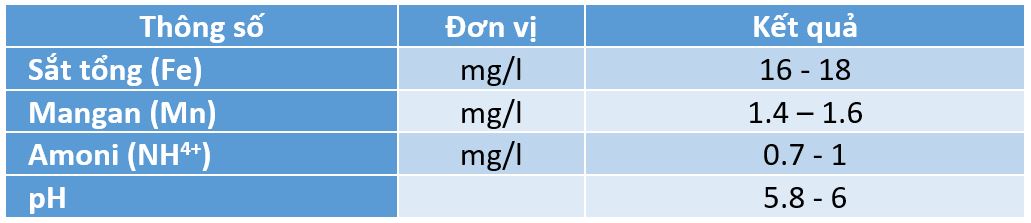
Currently, the water plant is applying two-step filtration technology of Iron and Manganese when treating groundwater. The pH of raw water is increased from pH = 5.8 to pH = 6.8-7, by means of natural oxygen. The water treatment process does not use chemicals at all, but the Fe and Mn content is almost completely eliminated, the results recorded are much lower than QCVN 01-1:2018/BYT.
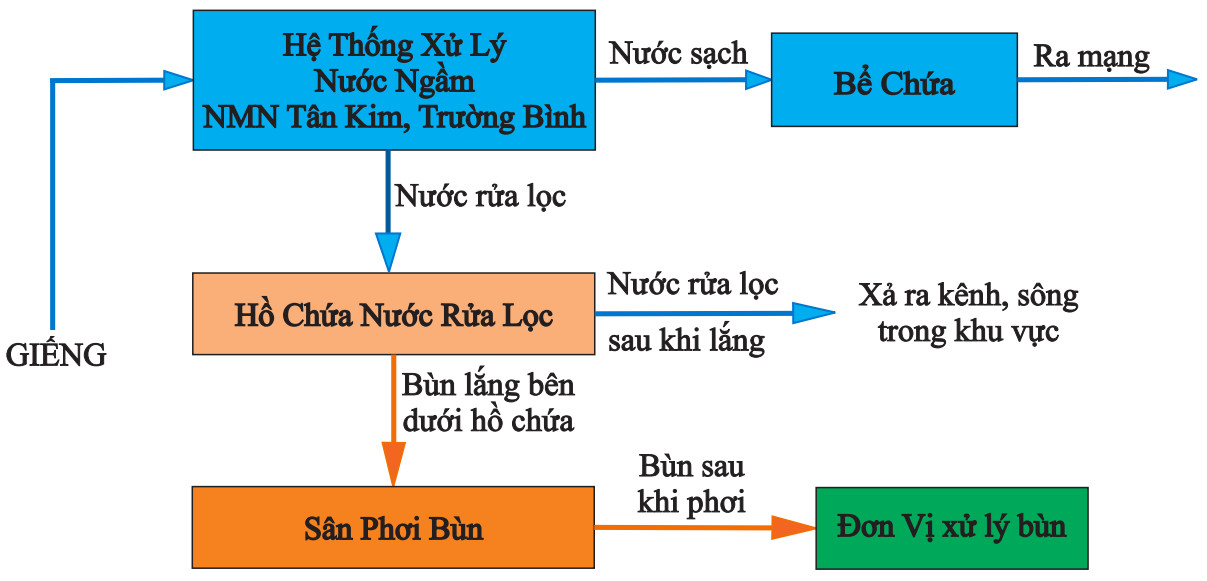
The clean water samples produced are not only of very good quality, but the operating and maintenance costs are very low because no chemicals are used in the water treatment process. However, after each day of operation, the filter tank will be clogged due to precipitation of iron and manganese, which must be washed. filter. The filtration cycle of iron and manganese filter baths is 24 hours and 72 hours, respectively. The flow of filtration water of iron filter tanks, each plant is 90 m3/day. The current processing technology transmission line is shown in figure 1.
Filter water quality at Tan Kim and Truong Binh Water Plants: The turbidity and pH index of the filter washing water are shown in Table 2 below:

According to the table above, the filtered wastewater does not meet the turbidity norm, the content of suspended solids in the water is very high, according to QCVN 40:2011/BTNMT standard. Therefore, it is necessary to treat it before being circulated and put into the clean water tank of the water plant.
Filter water circulation solution:
Pernam has applied a closed circulation technology solution. Recovery of filtered and treated water into production, green production model – sustainable development, environmental protection. Tan Kim and Truong Binh water plant technology lines after applying the filtered water circulation system are shown in Figure 2.
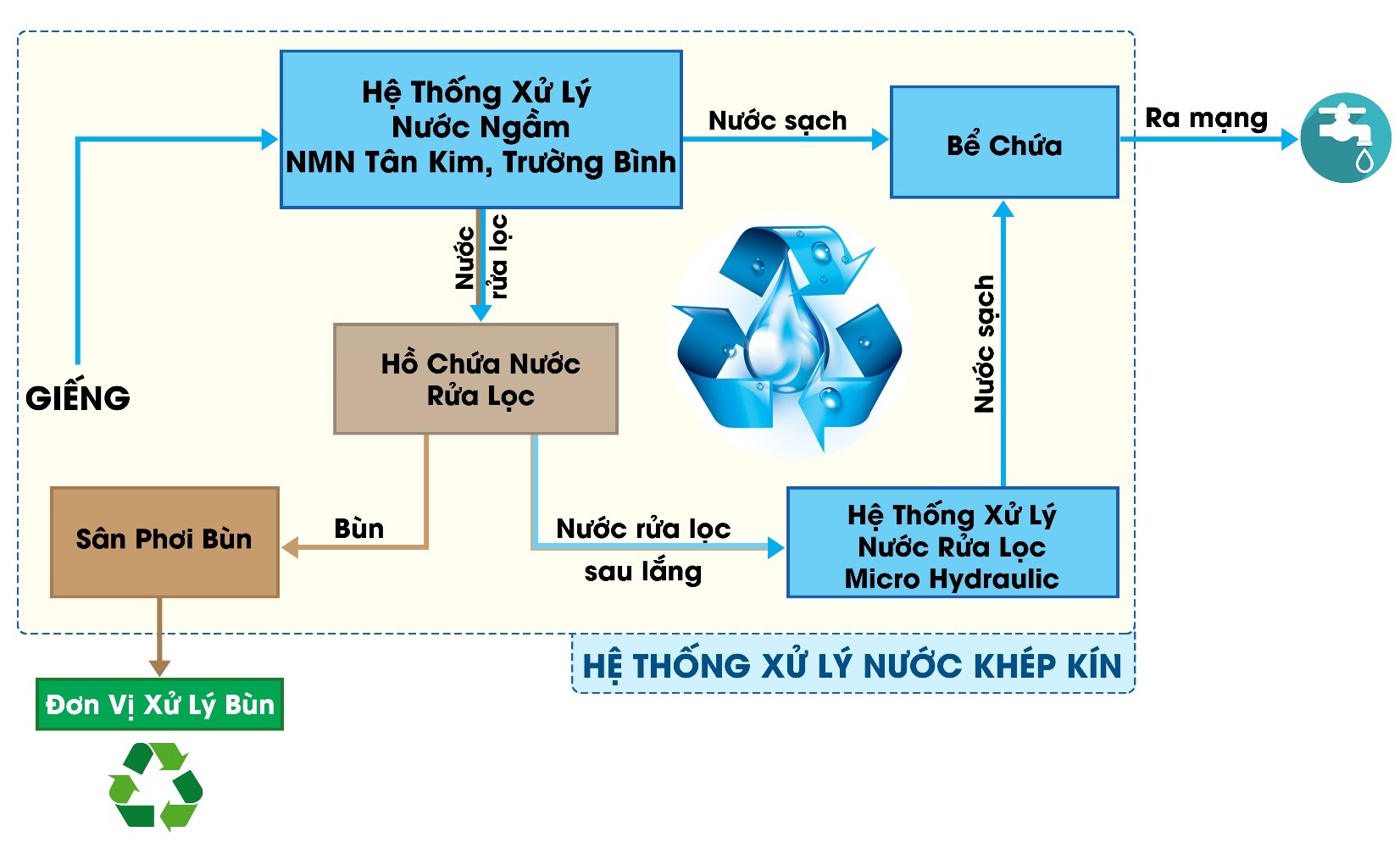
The amount of filtration wastewater after flowing into the filtration water reservoir is preliminarily settled, then pumped through the filtration water circulation system. Here, Micro Hydraulic surface water treatment technology is applied - capacity of 6 m3/h (see references 1 and 2). The filtered water is treated to meet QCVN 01-1:2018/BYT standards, then pumped directly into the clean water tank and supplied to the consumption network. The amount of sludge in the reservoir will be pumped into the mud drying yard. After 14 days of dry, compressed sludge was transported by Saigon Green Company to Da Phuoc treatment area (Ho Chi Minh City).
Improvement of the filtration water reservoir:
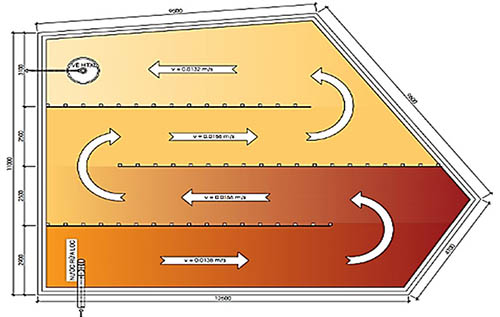
The filter water has a very high content of Fe3+ and Mn2+ residues, which need to be pre-settled before being pumped into the Micro Hydraulic Cooperative, to increase treatment efficiency and save chemicals (PAC). The filter wash water from the discharge point, will zigzag in the filter wash water reservoir. Designed flow velocity v= 0.01 m/s. Flow directional walls are installed to achieve the design velocity and increase the settling time at the filter wash reservoir (see figure 3).
Micro Hydraulic 3-D reaction technology applied to the recirculation of filtered water:
From May and July 2021, respectively, Pernam has completed the installation of filtered water circulation systems at Tan Kim Nuclear Power Plant and Truong Binh Nuclear Power Plant. The Micro hydraulic processing assembly is made of steel, with the technical parameters of: d × b × h = 2400 × 2000 × 2000 mm, capacity 5 - 6 m3/h. The technology chain is shown in Figure 4.
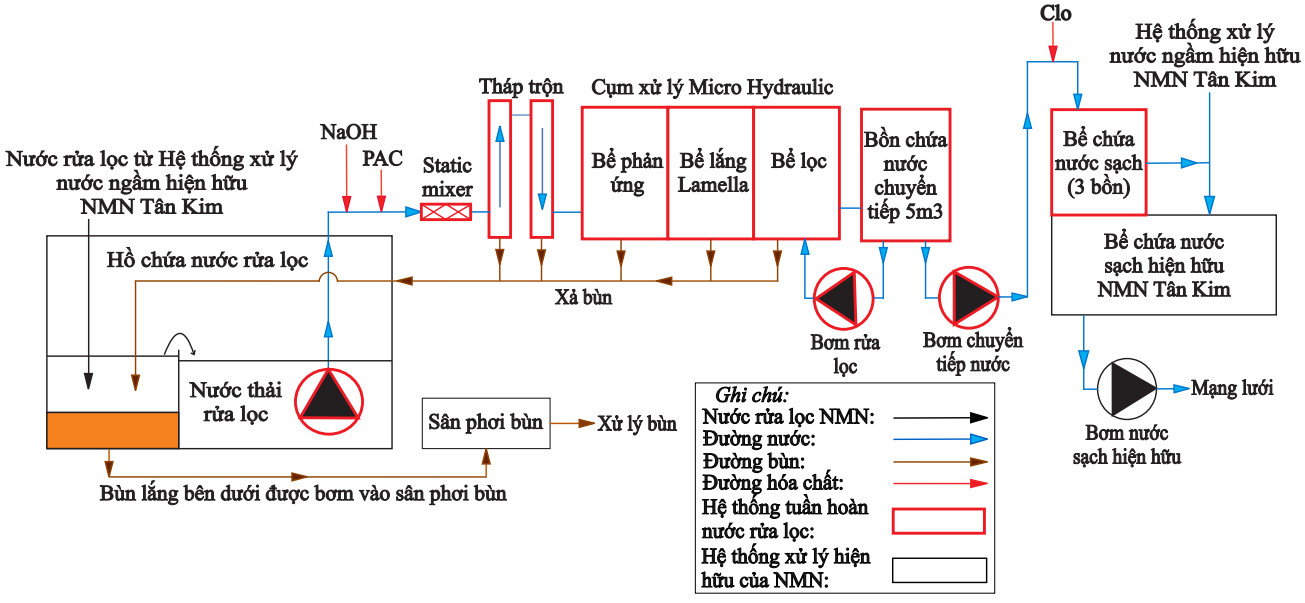
The raw water is pumped into the Micro Hydraulic Filter Treatment System (HTXL), the process of NaOH, PAC injection then into the Static mixer. The water will flow into the mixing tower in a spiral direction from the bottom to the end of the 1st tower and down at the 2nd tower, where the chemicals are evenly mixed into the water.
The next stage is the Micro Hydraulic reaction, the reaction compartments are divided into 4 compartments, micro-hydraulic vortexes of varying intensities flow through the flow guide plate, and gradually decrease from reaction compartments 1 – 3 to produce many large, easy-to-settle residues. Compartment 4 is a stable compartment, avoiding cotton breakage before passing the settling stage. At the lamella sedimentation chamber, due to the upward water flow being divided in 2 directions, it reduces the potential energy of the sediment particles, increases the sedimentation capacity and capacity utilization factor, and reduces the time for the sedimentation process. Finally, it will be the filter compartment, the remaining flowers will be captured in the filter sand layer with a size of 0.8 – 1.2 mm. The clean water flows freely into the transitional water tank and is pumped into the existing storage tank of the water plant.
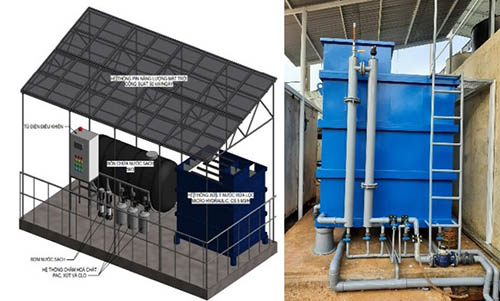
All equipment inside the filter water circulation system is operated from electrical energy provided by solar panels, trying to be integrated into the roof of the system, 1 solar panel 2x1m can supply 0.42x4 = 1.6kwh. The 3D image illustrates the filter water circulation system in figure 5.
Prior to the operation of the system, the Jartest experiment was carried out, which determined the optimal PAC and NaOH dosages of 20 g/m3 and 25 g/m3 respectively, achieving large-size, high-density and fast settling residues.
Turbidity after processing:
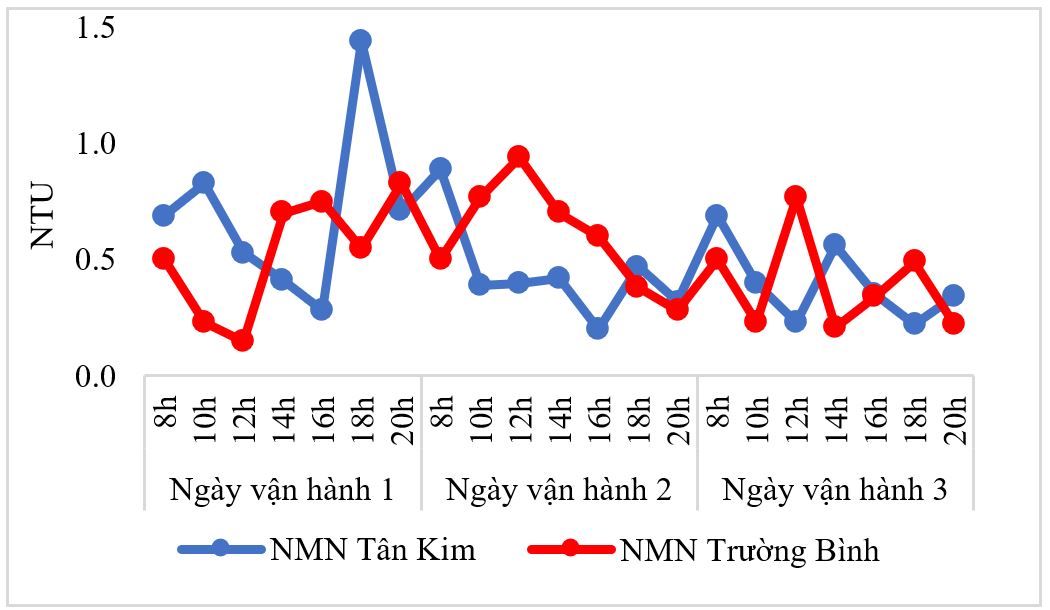
The water treatment process focuses mainly on the turbidity index. Detailed results are shown in Figure 6.
Evaluate the results:
Iron and manganese content (mg/l):
Since the Micro Hydraulic treatment system mainly handles suspended sediment content, reducing turbidity in water, after operation, iron and manganese content may still exceed the thresholds of 0.3 mg/l and 0.1 mg/l, respectively. However, when water is pumped from the transitional water tank to the 2 clean water tanks (placed above the existing water tank of the water plant), during this process, the disinfection chlorine is always pumped directly into the pipe, ensuring the disturbance and oxidation process continues the amount of Iron and Manganese inside the 2 clean water tanks.
In addition, when the water flows directly into the existing water storage tank of water plant, because the amount of filtered water circulated only accounts for 3% of the total flow in the tank, the concentration of Iron and Manganese will be diluted many times. Ensure that the concentration does not exceed the limit according to QCVN 01-1:2018/BYT.
Turbidity (NTU):
After the filtration process in the filtration water circulation system at Truong Binh water plant, the turbidity index decreased very low and was always maintained stably at ≤ 1 NTU. The index averaged at 0.5 NTU. The average amount of PAC consumed is 20 g/m3.
At Tan Kim Nuclear Power Plant, the results of turbidity analysis after the filtration process show that there is more fluctuation than the Truong Binh nuclear power plant system, but the turbidity is always guaranteed < 1.5 NTU. The mean index reached 0.5 NTU and the dosage of peppered PAC remained at 20 g/m3.
Sewage Sludge Treatment Process:
After the treatment and circulation of the filtration wastewater, the amount of sludge settled under the filtration water reservoir will be pumped directly into the sludge drying yard. There are 2 options that can be combined to treat sludge.
Option 1: Mud drying yards are being applied at 2 Tan Kim and Truong Binh nuclear plants with an area of 50 – 55 m2 respectively. The amount of waste sludge will be pumped and dried in the sludge drying yard until the humidity decreases. The drying time of 1 batch of sludge is about 18 days/yard, the sludge after drying will be collected into bags and transported to Da Phuoc waste treatment area, Ho Chi Minh City. The processing process is simple, the operating cost is low. But the waiting time for the mud to dry is long, and the humidity is still about 230% high.
Option 2: Sludge dewatering machine: The amount of waste sludge will be injected into the sludge dewatering machine, combining Polymer to increase sedimentation, water separation and increase the concentrated quality of sludge. The processing process is fast, the sludge is produced with a low moisture content of about 85%. However, it is necessary to have other construction items such as: Foundations for sludge compression tanks, houses for sludge presses, polymer acupuncture systems. In addition, the processing process always has to be staffed and handled, and the operating and maintenance costs are high.
Cost of investment in water circulation system, washing and sludge treatment:
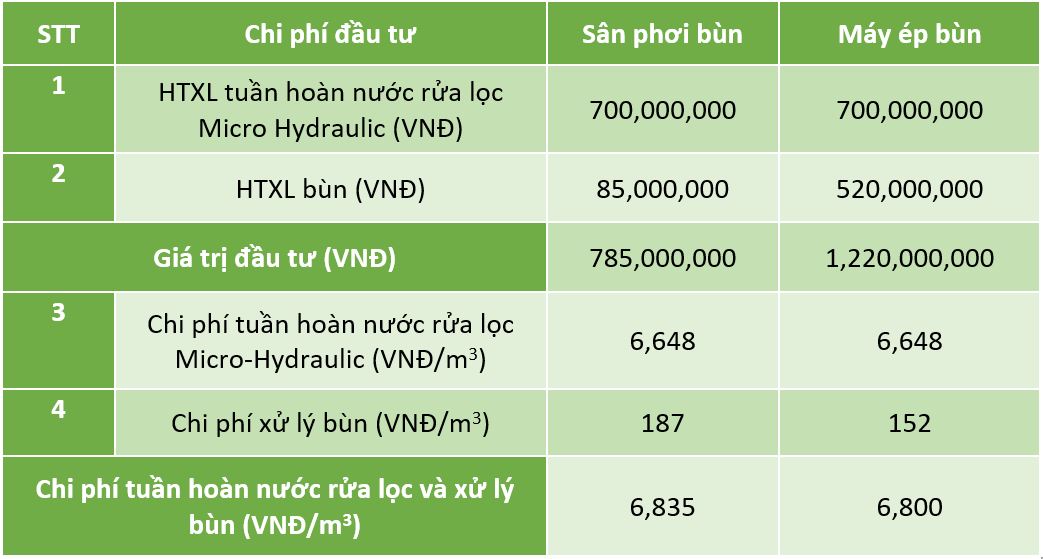
The investment in a recirculating water treatment system, washing and sludge treatment is considered an economically effective Green Solution. Based on actual data at Tan Kim Nuclear Power Plant and Truong Binh Nuclear Power Plant, the price is about 6,800 VND/m3, lower than the average selling price of domestic water of 8,000 VND/m3.
Capacity of the filter water treatment system: 6 m3/h. Operating time: 15 hours/day. The cost is shown in Table 3.
Conclude:
Every day, the amount of filtration wastewater can reach 90 m3 per plant, polluting components with high concentrations such as turbidity, iron and manganese. The Micro Hydraulic Filter Water Recirculation System is installed with the main goal of creating a completely closed production system in the Water Plant, no more wastewater discharged to the outside. The water quality after being treated with iron and manganese content is lower than the norm, the turbidity is always maintained at more than 1.5 NTU, the pH index is stable at 6.8 – 7. After that, it will be circulated and pumped directly into the existing clean water tank of the factory. As a source of waste, it will be discharged to the outside and has a very high pollution potential, directly affecting the environment, the circulation and reuse not only contribute to reducing the burden on the water supply industry but also take advantage of and save fresh water resources.
The cost to treat 1 m3 of filtration wastewater is 6,648 VND/m3 when installing a filtration water circulation system. The cost of treating the waste sludge is at 187 VND/m3 (mud drying yard) and 152 VND/m3 (sludge press). In addition, the application of energy batteries to the entire production process at the factory, can not only greatly cut operating costs, but also well implement clean production for sustainable development, realizing the strategy of developing a green, sustainable and economically efficient economy.
------------------------
Bibliographic references:
[1] Vietnam Water Supply and Sewerage Journal, "Improving the quality and increasing the capacity of surface water treatment systems with multi-jet chemical injection technology and micro-hydraulic foaming reactions", 2019.
[2] Vietnam Journal of Water Supply and Sewerage, "Efficiency of multi-beam mixing technology, 3d micro-hydraulic flocculation reaction and lamella sedimentation in surface water treatment lines", 2020.
KS. Trương Minh Hiền
KS. Ngô Nhật Hoàng Phong
KS. Nguyễn Thành Công
Công ty CP TV - TK - XD Hoàn Mỹ Việt Nam (PERNAM)


